See how PREXA365 helps rental businesses grow
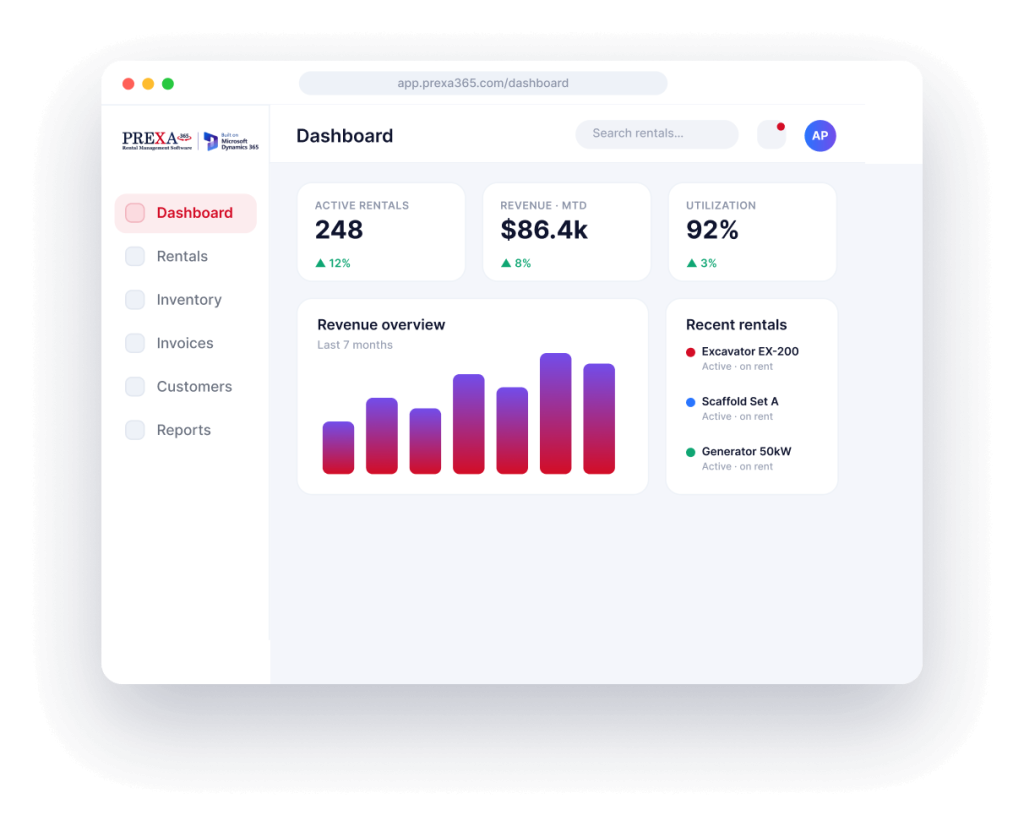
Construction equipment rental software connects the customer, equipment, job site, rental dates, transport, inspection, maintenance, and billing records involved in every rental.
Construction rental companies rarely manage simple counter transactions alone.
A customer may request an excavator for one project, attachments for another location, and delivery during a narrow site-access window. The equipment may require inspection before dispatch, scheduled service during a long rental, and a condition review when it returns.
When sales, operations, transport, service, and finance maintain separate records, important changes can easily remain inside emails, spreadsheets, calls, or personal notes.
A connected process gives each department access to the information needed for its work while preserving clear responsibilities and approvals.
Here is why rental-management technology has become an important operational foundation for construction equipment rental companies.
Construction Rentals Begin with Detailed Customer Requirements
A construction-equipment enquiry needs more than a customer name and rental date.
The rental team may need to understand:
- Equipment category
- Required capacity or specification
- Job-site address
- Planned start and end dates
- Expected operating conditions
- Required attachments
- Delivery and collection requirements
- Project contact
- Access restrictions
These details affect equipment selection, transport, availability, pricing, and preparation.
If the customer’s information remains inside an email while sales creates a quotation from a separate spreadsheet, operations may not receive the complete requirement.
A connected construction rental management system keeps the enquiry, customer, job site, requested equipment, dates, and quotation associated with one rental process.
Software should not choose equipment for the customer automatically. Capacity, site conditions, intended use, access, and technical suitability may require further review by qualified people.
The platform should preserve those requirements so the appropriate employees can assess them.
Quotations Need More Than an Equipment Rate
Construction rental quotations may include equipment, attachments, delivery, collection, fuel, usage allowances, field service, deposits, and other approved charges.
Prices may vary by equipment category, customer agreement, branch, rental duration, project, or expected usage.
A quotation should identify which rate structure was used and whether any exception required approval.
Project dates and requirements may also change before the customer accepts the quote.
Employees need to preserve previous versions and confirm which version became the rental order.
Once a quotation is approved, the customer, dates, job site, pricing, equipment requirement, and services should move into the rental record without being entered again.
Repeated entry increases the risk of inconsistent dates, locations, or charges.
Future Availability Is More Important Than Current Stock
A machine can be physically present at the depot and still be unavailable.
It may already be reserved, awaiting inspection, under maintenance, scheduled for another branch, or missing an essential attachment.
Availability needs to reflect a specific period.
The complete rental window may include:
- Preparation
- Pre-rental inspection
- Delivery
- Active rental
- Collection
- Return inspection
- Cleaning, refuelling, maintenance, or approval
A loader returning on Friday may not be ready for another customer on Saturday morning.
The business may need time to collect the asset, inspect its condition, confirm attachments, record meter readings, refuel it, and complete any required work.
Suitable construction equipment rental management software should also recheck availability when a customer requests an extension.
Keeping one asset at the current site for another week may affect the next customer, planned transport, preventive maintenance, or an interbranch transfer.
The system exposes the conflict. Employees still need to decide whether to allocate another machine, revise the dates, rerent equipment, or discuss alternatives with the customer.
Individual Asset Assignment Protects Equipment History
Customers initially request an equipment category or specification.
The exact serialized unit may be selected later based on location, condition, utilization, meter readings, maintenance status, and future demand.
The platform should preserve both:
- The equipment class requested
- The individual asset delivered
This distinction supports flexible fleet planning.
Sales may reserve one 20-tonne excavator without selecting a particular serial number several weeks in advance. Operations can assign the most suitable unit closer to dispatch.
If the original asset fails inspection, employees may substitute another machine without rebuilding the complete rental.
The first and replacement assets should retain individual histories.
Overwriting the original serial number removes the record of which machine had the issue, when it became unavailable, and what action followed.
Reliable construction equipment management software keeps the commercial order connected while preserving asset-level details.
Attachments Must Remain Visible
A primary machine may be ready while the attachment required by the customer remains unavailable.
Excavators may need buckets, breakers, augers, or grapples. Loaders may require forks or particular buckets. Generators may depend on cables or distribution equipment.
The order should associate each important attachment with the main equipment and job.
Serialized attachments need their own location, condition, rental, transfer, and maintenance histories where appropriate.
Quantity-based components should update the correct branch inventory.
Package controls should remain flexible.
If one attachment changes, employees should be able to substitute the affected component without replacing the entire rental record.
The system should also compare the complete expected package with the items delivered and returned.
Dispatch and Transport Need the Same Rental Record
Construction equipment often requires planned delivery and collection.
Transport may involve internal vehicles, outsourced carriers, route restrictions, permits, loading, unloading, access instructions, and narrow delivery windows.
The dispatch record should show:
- Equipment and attachments
- Collection point
- Job-site address
- Site contact
- Planned delivery window
- Assigned driver or carrier
- Access instructions
- Movement status
If operations changes the assigned machine, the transport record must change accordingly.
Otherwise, the customer order may show one serialized asset while dispatch sends another.
The receiving confirmation also matters.
A dispatch record showing that equipment left the depot does not confirm that it reached the site in the expected condition.
On-Rent Changes Must Reach Every Department
Construction projects rarely follow the original rental plan exactly.
A customer may request an extension, additional equipment, another attachment, a different collection point, or a replacement asset.
Each approved change may affect:
- Availability
- Transport
- Maintenance
- Future bookings
- Pricing
- Billing
- Customer communication
An extension should not remain inside a phone conversation between the site and one employee.
It needs to update the shared rental dates before another team promises the equipment elsewhere.
During an equipment exchange, the original machine should retain its return date, reading, condition, issue, and maintenance status.
The replacement should receive its own dispatch, opening reading, condition record, and customer assignment.
A connected construction equipment hire software process keeps the rental relationship intact while preserving the histories of both assets.
Inspections Should Control Availability
A returned machine should not move directly into the available fleet.
It may have new damage, missing attachments, unusual readings, a reported fault, or another condition requiring review.
A return inspection may record:
- Asset and serial numbers
- Date and location
- Meter reading
- Condition
- Attachments
- Photographs
- Reported concerns
- Required next action
If the machine fails inspection, its status should stop another assignment.
A note in an email cannot protect the next booking when the rental system still marks the equipment as available.
Inspection completion also does not necessarily mean the equipment can return to service.
Assessment, repair, testing, cleaning, refuelling, documentation, or approval may remain outstanding.
Software records the findings and restrictions. Qualified employees remain responsible for the inspection, technical decision, repair, and approval.
Maintenance Must Be Planned Around Customer Demand
Construction machines may require service according to dates, operating hours, mileage, readings, inspection findings, or manufacturer guidance.
The maintenance schedule and rental schedule should not operate separately.
A machine may appear free for a long-term rental while approaching a service threshold during the proposed period.
The platform should make the potential conflict visible before confirmation.
The service record may also include open work, parts, technicians, external providers, downtime, testing, and return-to-service approval.
Specific work stages provide more useful information than a general “under maintenance” status.
For example:
- Under Assessment → Approved → In Progress → Awaiting Parts → Testing Required → Approval Pending → Available
This helps operations understand why the equipment remains unavailable and who owns the next action.
Multi-Site Visibility Supports Better Fleet Allocation
Construction rental companies may operate across several depots, regions, and project locations.
One branch may experience repeated shortages while another holds underused equipment.
Company-wide visibility can help teams identify potential transfer options.
However, visibility alone is not enough.
A transfer should preserve the source, destination, date, equipment identity, transport activity, condition, receiving confirmation, and updated responsibility.
The receiving branch should not see the asset as available before arrival and required checks are complete.
Frequent transfers may indicate that equipment is positioned poorly. They may also reflect specialist demand or temporary projects.
A fleet-utilization review can help teams compare location, demand, availability, rental activity, and equipment performance before making purchasing or permanent-reallocation decisions.
Billing Should Reflect What Actually Happened
The final invoice may differ from the original quotation.
The customer may have extended the rental, exceeded an operating-hour allowance, requested another delivery, added equipment, or returned assets separately.
Finance needs the approved rental history, not only the original quote.
The record should connect:
- Accepted quotation
- Actual rental dates
- Equipment supplied
- Meter readings
- Transport activity
- Exchanges
- Partial returns
- Approved additional charges
- Final invoice
The business should define which activities create charges and who approves them.
Automation can reduce repeated entry, but it should not add disputed or unsupported charges automatically.
Every invoice amount should remain traceable to the relevant rental term, equipment activity, or approved change.
Connected Reporting Improves Fleet Decisions
Construction rental companies need to understand more than total revenue.
Managers may review utilization, availability, downtime, maintenance cost, transport activity, revenue by asset, branch demand, repair frequency, and lost opportunities.
These measures need context.
Highly utilized equipment may generate strong revenue while leaving little time for planned maintenance. A specialist machine may work fewer rentals but serve high-value projects.
Low utilization may result from weak demand, unsuitable location, condition, pricing, missing attachments, or maintenance restrictions.
The Federal Reserve Bank of St. Louis reports, using U.S. Bureau of Labor Statistics data, that U.S. construction employment reached a seasonally adjusted 8.359 million workers in August 2026. The figure covers the wider U.S. construction workforce and does not measure equipment-rental-company employment or software use.
The scale of construction activity provides broader context for why rental companies need dependable equipment, customer, and project information.
Reports should allow managers to open the assets and transactions behind each figure.
Technology supplies evidence. Employees make the purchasing, transfer, repair, replacement, and disposal decisions.
Customer Information Should Remain Connected
Construction customers may operate across several projects, contacts, job sites, and rental agreements.
The system should preserve the difference between:
- Customer account
- Contact
- Project
- Job-site address
- Quotation
- Rental
- Invoice
Creating a new customer record for every project can fragment rental history and pricing.
Using only the customer’s head-office address can create dispatch errors when equipment belongs at a separate job site.
A connected system gives sales, operations, service, transport, and finance a consistent customer view while limiting access according to employee responsibilities.
What to Test During a Demonstration
Ask each provider to process one realistic construction rental.
Begin with a customer enquiry for a machine, attachment, and future delivery.
Confirm whether the platform preserves the customer, project, equipment, dates, movement, inspection, change, and billing history.
Also ask which requirements are standard, configurable, integration-based, custom, or unavailable.
Conclusion
Construction equipment rentals connect customers, jobs, assets, attachments, transport, inspections, maintenance, billing, and fleet decisions.
Managing these activities through disconnected records makes it harder for employees to see the current rental position and respond when plans change.
The right construction equipment rental software maintains one dependable transaction from enquiry to invoice while preserving the individual histories of every important asset.
Begin by documenting your current process. Identify where information is repeated, delayed, or missing. Then test each shortlisted system using the exceptions your teams manage regularly.
Ready to assess PREXA365 against your construction-equipment rental workflow? Book a free demo using customer, job-site, equipment, transport, maintenance, and billing scenarios from your operation, or email sales@prexa365.com to discuss your requirements.