
Rental Equipment Depreciation: Challenges and Solutions
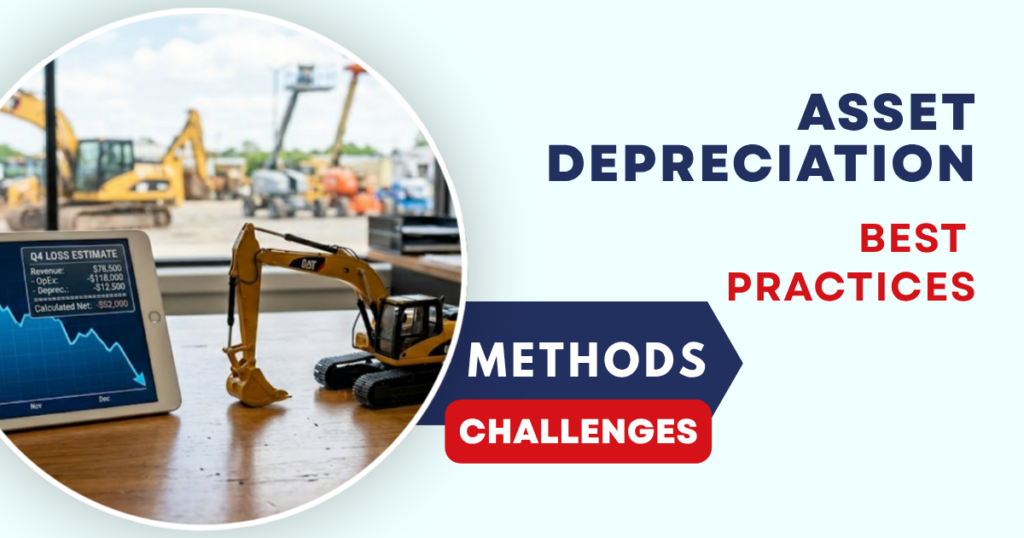
Picture this scenario: you are reviewing your rental business financials at the end of the quarter. You notice that a specific excavator generates consistent revenue, but you are still facing higher-than-expected expenses, which lowers your actual profit margin. If you look closely, you might spot a hidden issue: poorly calculated depreciation. Understanding rental equipment depreciation, hence, becomes key to a clearer business here.
When you fail to account for the rate at which your machinery loses value, you continue to underprice your rentals and spend heavily on repairs. Accurately tracking equipment depreciation is required for making solid financial decisions. It is not just an accounting task; it is a vital metric that guides repair schedules, replacement decisions, and rental pricing.
This guide explains the basics of rental equipment depreciation, the most common calculation methods, and the risks associated with miscalculating your asset values.
What is rental equipment depreciation?
Rental equipment depreciation refers to the gradual loss of value in your rental assets due to everyday wear and tear, age, and obsolescence. Tracking this financial decline and knowing how to calculate asset depreciation within a rental software helps you understand the actual cost of keeping equipment in your fleet, making it easier to make logical replacement decisions.
Calculating depreciation correctly helps rental businesses:
- Establish rental prices that cover initial costs and profit margins
- Determine the exact moment to retire or replace an asset
- Forecast cash flow and plan for future inventory purchases
To illustrate this, consider a $50,000 generator with an expected useful life of five years and a salvage value (its estimated resale value at the end of its life) of $5,000. Using basic straight-line depreciation, the calculation looks like this:
($50,000 – $5,000) / 5 = $9,000 per year.
This $9,000 is recorded as an annual expense, helping you recover the original cost of the asset over its lifespan.
Depreciation methods used in the rental industry
Choosing the correct method to calculate depreciation forms the basis of your revenue calculations. Every business uses different approaches depending on the type of fleet, rental models, and usage data. Here are the primary methods for calculating how your inventory loses value.
Straight-Line Depreciation
This is the most common and simple method for calculating depreciation. The asset loses value evenly across its entire useful life.
Formula: (Purchase Cost – Salvage Value) / Useful Life
AV equipment suppliers, general tool rental companies, and party rental businesses often rely on this method. It is best suited for items that:
- Perform consistently throughout their lifespan
- Have steady, predictable usage patterns
- Require simple accounting practices
Annual depreciation expense shows how much of an asset’s depreciable cost is allocated during a financial year.
Under the straight-line method:
Annual Depreciation = (Equipment Cost − Residual Value) ÷ Useful Life
For example, suppose a rental company purchases equipment for $120,000, expects to sell it for $20,000, and assigns it a useful life of 5 years.
Annual depreciation would be:
($120,000 − $20,000) ÷ 5 = $20,000 per year
The equipment must therefore generate enough rental income to recover at least $20,000 of annual depreciation, along with maintenance, insurance, financing, transportation, labour, and other operating expenses.
According to Wikipedia’s explanation of depreciation, straight-line depreciation allocates the difference between an asset’s original cost and residual value evenly over its useful life.
Declining Balance Depreciation
This method records higher depreciation expenses in the early years and less as the equipment ages. It is an accelerated depreciation method best suited for heavy machinery, such as boom lifts, excavators, and high-tech testing equipment.
Rental businesses often use this method because:
- Heavy equipment loses its market value rapidly in the first few years
- It matches real-world usage, where wear and tear is heavier initially
- It offsets higher maintenance costs that usually occur later in the asset’s life
Units of Production Method
Here, depreciation is measured based on actual usage, tracking hours of operation or miles driven.
Formula: (Purchase Cost – Salvage Value) / Total Expected Usage
This method is highly accurate because it reflects real-world operations rather than simply measuring time. It is highly effective for equipment that experiences heavy variations in usage depending on the season, such as:
- Excavators are measured in operating hours
- Rental trucks are measured in mileage
- Generators are measured in cycles
Sum-of-the-Years’ Digits (SYD)
SYD is another accelerated method where depreciation is highest in the early years and decreases over time. It is less common than the declining balance method but works well for assets that rapidly lose their initial value and require heavy maintenance later on.
Tax-specific depreciation (MACRS in the U.S.)
Many rental businesses must use tax-based depreciation methods, such as the Modified Accelerated Cost Recovery System (MACRS), for reporting purposes. These regulations dictate exactly how quickly you can deduct the depreciation of an asset on your tax returns, offering tax relief during the early years of equipment ownership.
Factors influencing equipment depreciation
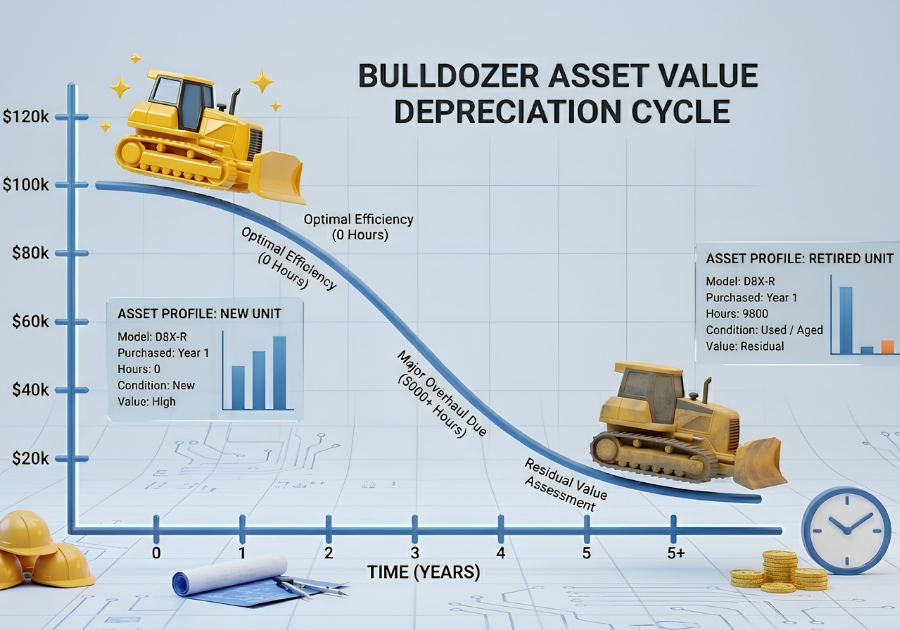
Several distinct variables influence how quickly an asset depreciates, which directly impacts your cash flow.
- Usage and utilization – The more frequently you rent out a piece of equipment, the faster it will depreciate. High utilization contributes to heavy wear and tear, shortening the asset’s lifespan. Tracking the relationship between depreciation and usage is crucial for maintaining proper pricing.
- Age of equipment – Older equipment depreciates differently than brand-new items. Physical damage, rough handling by clients, and exposure to the elements deteriorate the equipment’s condition and accelerate its financial decline.
- Maintenance practices – How you care for your equipment determines how quickly it wears down. Well-maintained machinery lasts longer than poorly serviced equipment. Regular inspections and proper lubrication reduce major mechanical failures, extending the period over which you can generate revenue.
- Technological obsolescence – Equipment loses value rapidly when newer, more advanced models enter the market. Customers prefer the latest technology because it is usually safer and more efficient. Outdated machinery eventually becomes obsolete, requiring you to update your fleet to remain competitive.
- Market value and equipment demand – Market demand dictates how well an asset holds its value. Certain machinery, such as skid steers and specialized forklifts, hold high resale value because they remain useful across various industries. Conversely, equipment that is no longer trending or highly requested will depreciate faster as newer versions replace it.
Top 7 depreciation KPIs for an equipment rental business
Monitoring specific Key Performance Indicators (KPIs) helps assess equipment performance alongside accounting data.
- Equipment Utilization Rate: Calculates the time an item is rented compared to its total available time. High utilization helps recover asset costs faster.
- Depreciation Expense per Asset/Per Hour: Tracks the actual cost of using the equipment based on hours operated.
- Book Value / Net Asset Value (NAV): Shows the current financial worth of the equipment, guiding replacement and investment choices.
- Maintenance-to-Depreciation Ratio: Indicates if assets are being over-maintained or under-maintained relative to their declining value.
- Return on Asset (ROA): Measures the efficiency of each asset in generating profit relative to its current value.
- Fleet Age / Average Age of Equipment: Monitors the average age of the entire fleet to schedule timely replacements.
- Residual Value Realization: Compares the estimated resale value versus what you actually received when selling the assets.
How miscalculated depreciation impacts rental operations
Miscalculating depreciation creates a long-term negative impact on your business. It distorts your financial reality and creates a ripple effect across your operations.
Distorted equipment valuation
Identifying your equipment’s true value is crucial foraccurate financial reporting. If you underestimate depreciation, you overstate your profits. If you set rental prices based on faulty depreciation figures, you might believe you are earning a healthy margin while actually losing money on every rental due to hidden wear and tear costs.
Skewed maintenance scheduling
A highly depreciated asset requires more frequent maintenance. If your records do not reflect the true state of the equipment, you might delay necessary servicing. This leads to unexpected breakdowns in the field, costing you repair money and damaging customer trust.
Poor cash flow forecasting
Depreciation helps you anticipate equipment retirement and build replacement funds. If a loader is incorrectly valued, the cost of replacing it can suddenly overwhelm your budget. Accurate data is necessary for projecting your future capital needs.
Compliance-related issues
Rental businesses must follow specific accounting standards, such as Generally Accepted Accounting Principles (GAAP). Failing to apply correct depreciation methods can result in compliance failures, audit issues, and legal penalties.
Insufficient capital allocation
When an item reaches the end of its usable life, you need funds ready to replace it. Miscalculating depreciation means you will not set aside enough money for new equipment, forcing you to delay purchases or rely on expensive financing options.
5 best practices to manage the depreciation of your rental fleet
Applying basic management strategies ensures your depreciation records remain accurate and useful.
Choose the right depreciation method
Not all equipment depreciates the same way. Heavy machinery experiences significant wear and tear, making units of production or the declining-balance method appropriate. Simple tools may only require straight-line depreciation. Evaluate your inventory and apply the method that accurately represents how each item loses value.
Track equipment utilization effectively
You must know exactly which pieces are used most frequently. Tracking usage allows you to adjust depreciation rates based on actual workload. High-utilization equipment requires faster depreciation schedules compared to items that sit idle in the warehouse.
Invest in rental equipment management software
Manual calculations using spreadsheets are slow and prone to errors. Relying on equipment rental software provides a solid foundation for organizing your fleet. A dedicated system tracks your assets, monitors maintenance logs, and stores crucial financial data in a single location, reducing the administrative burden on your team.
Deprecation-based rental strategies
Your pricing structure must include the best pricing strategies for rental assets and account for how quickly your machinery depreciates. If a piece of equipment loses $10 in value for every hour it runs, your hourly rental rate must cover that $10 just to break even on the asset of wear. Use accurate depreciation data to set realistic rental rates.
Assess the valuable life of a piece of equipment
The salvage value of your equipment changes depending on market conditions and usage history. A generator might have a stated useful life of ten years, but heavy use in harsh conditions might reduce that to seven. Regularly review your inventory to ensure your expected lifespans match the physical reality of the machines.
Turning depreciation into a strategic advantage
Depreciation is an unavoidable expense that directly impacts revenue. Tracking it correctly requires solid record-keeping and an understanding of how your assets perform in the real world. By keeping close watch over your fleet’s declining value, you can adjust your pricing accurately and ensure you always have the capital required to keep your inventory fully stocked and ready for the next job.
Conclusion
Equipment depreciation is influenced by more than age alone. Utilization, operating conditions, maintenance quality, technological changes, and market demand all affect how quickly rental equipment loses value. Understanding these factors helps rental companies make better decisions about pricing, preventive maintenance, fleet replacement, and equipment disposal.
The real challenge is bringing this information together. When usage hours, service history, asset condition, rental revenue, book value, and resale performance are managed in separate systems, it becomes difficult to understand the true profitability of each asset.
PREXA365 helps rental businesses manage equipment availability, rental contracts, inspections, maintenance, billing, and asset information through a connected rental management platform. With better visibility into the complete equipment lifecycle, businesses can identify underperforming assets, reduce avoidable downtime, plan replacements more effectively, and protect the long-term value of their fleet.
To see how the solution can support your rental operations, you can request a free demo, or call at +1(905)917-0365 to discuss your equipment and fleet-management requirements.
Managing depreciation effectively is not simply about recording the declining value of equipment. It is about using accurate operational and financial information to keep every asset productive, profitable, and valuable for as long as possible.
Frequently Asked Questions
Can I still depreciate an item if I finance my rental equipment?
Yes. When you finance an item, you still own the asset and hold it on your balance sheet. You can depreciate it over its useful life, while separately claiming interest expenses on your loan.
How should I adjust to depreciation if my equipment's lifespan changes?
If heavy usage shortens the useful life of a machine, you need to recalculate your depreciation schedule. You will divide the remaining book’s value by the newly estimated remaining years (or hours) to find the adjusted depreciation rate moving forward.
How do I choose between declining balance and straight-line depreciation?
Straight-line is best for assets that lose value evenly over time, such as basic tools or staging equipment. Declining balance is better for items that lose a large portion of their value immediately after purchase, such as vehicles or heavy construction machinery.
Does depreciation help me decide whether to repair or replace equipment?
Yes. By comparing your maintenance-to-depreciation ratio, you can see if you are spending more money fixing a machine than the machine is actually worth. If repair costs consistently exceed the asset’s declining value, it is usually time to replace it.


