
Using Financial Asset Management Software to Manage Rental Equipment Depreciation
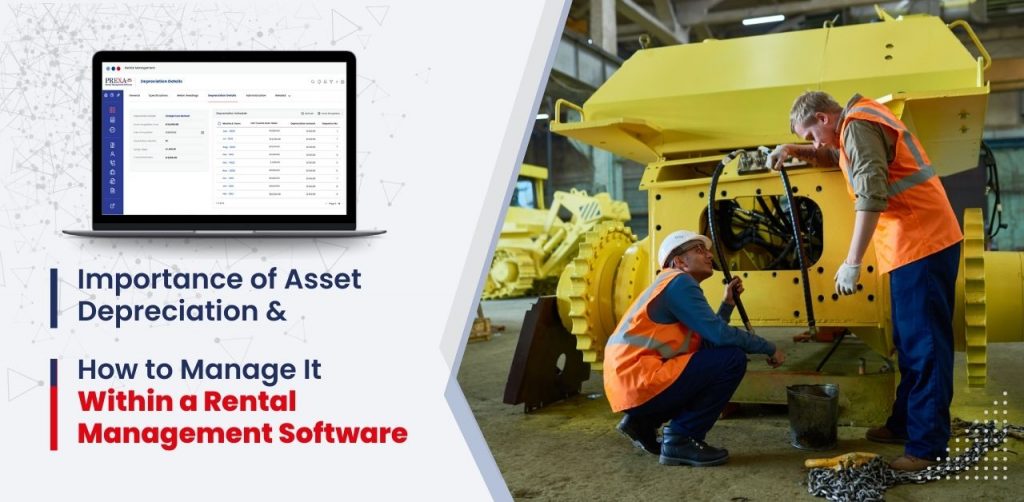
Rental equipment starts losing value as it ages, operates, experiences wear, and becomes less aligned with current market requirements.
For rental businesses, this decline can affect accounting records, rental-rate reviews, asset planning, financial reporting, and equipment replacement decisions. A structured financial asset management software process can help connect acquisition details, depreciation records, maintenance history, rental activity, and current asset status.
Understanding the fundamentals of depreciation helps rental businesses maintain more dependable records and make better-informed equipment decisions.
What Is Asset Depreciation?
Depreciation is the systematic allocation of an asset’s depreciable amount over its estimated useful life.
In practical terms, it recognises that a rental asset provides value for several accounting periods rather than becoming a complete expense when the company purchases it.
The calculation generally considers four important elements:
- The original cost of the asset
- Its estimated useful life
- Its expected salvage or residual value
- The depreciation method used
The original asset cost may include more than the supplier’s invoice. Depending on the company’s accounting policy, costs directly required to prepare the equipment for use may form part of its recorded value.
Salvage value estimates what the business expects to recover when the asset reaches the end of its useful life. Useful life estimates how long the company expects the asset to provide economic value.
These figures are estimates and may require periodic review according to the accounting framework and company policy.
An asset management system should preserve the estimates, their effective dates, and the authorized changes made over the asset’s life.
Common Asset Depreciation Methods
The appropriate depreciation method depends on how an asset is expected to provide economic value.
Accounting depreciation and tax depreciation may follow different rules. Rental companies should consult qualified accounting and tax professionals before selecting or changing a method.
1. Straight-Line Depreciation
Straight-line depreciation allocates an equal depreciation expense to each accounting period over the asset’s estimated useful life.
It may be suitable when the asset is expected to provide economic value relatively evenly throughout that period.
2. Declining-Balance Depreciation
Declining-balance depreciation recognises a larger depreciation expense during the earlier years of an asset’s useful life and smaller amounts in later years.
This method may be considered for equipment expected to lose economic value more quickly when new.
Double-declining balance is a common accelerated method. It generally applies twice the straight-line depreciation rate to the asset’s opening book value for the relevant period.
Because the opening book value decreases over time, the depreciation amount also declines.
The company should confirm the depreciation rate, salvage-value treatment, useful life, and applicable accounting rules before applying an accelerated method.
Accounting and Tax Depreciation Are Different
Rental companies should distinguish financial-reporting depreciation from tax depreciation.
Accounting depreciation aims to reflect how an asset’s economic value is consumed under the relevant financial-reporting framework.
Tax depreciation determines the deductions available under jurisdiction-specific tax rules. Recovery periods, asset classifications, deduction limits, and permitted methods may differ from the company’s accounting records.
For example, the Internal Revenue Service states that, for U.S. tax years beginning in 2025, the maximum Section 179 expense deduction is $2,500,000, subject to eligibility requirements, expenditure limits, taxable-income rules, and other conditions. This figure applies to U.S. federal tax treatment for 2025 and should not be used without professional review.
Tax rules can also change according to legislation, acquisition date, placed-in-service date, asset classification, business use, and jurisdiction.
A software calculation should not replace advice from a qualified accountant or tax professional.
Maintain Complete Depreciation Records
Reliable depreciation depends on complete asset information.
Each depreciable rental asset should have a record containing:
- Asset number and serial number
- Supplier and purchase date
- Acquisition and placed-in-service dates
- Original cost
- Approved capitalized costs
- Depreciation method
- Estimated useful life
- Estimated salvage value
- Accumulated depreciation
- Current net book value
- Disposal date and proceeds
Supporting documents may include the supplier invoice, receiving record, capitalization approval, improvement documents, valuation records, and disposal information.
A Rental Asset Management Software process should also maintain an audit history when an authorized employee changes the useful life, salvage value, asset classification, or depreciation method.
The history should show what changed, when the change occurred, why it was made, and who approved it.
Include Depreciation in Rental Pricing Reviews
Depreciation represents one part of the cost of owning rental equipment.
A rental rate may also need to consider maintenance, insurance, financing, storage, transport, preparation, administration, expected utilization, and required financial contribution.
However, dividing annual depreciation by expected rental days does not automatically produce the correct market rate.
Pricing also depends on:
- Equipment demand
- Rental duration
- Customer agreements
- Regional conditions
- Availability
- Included services
- Competitor pricing
- Equipment condition
A guide to calculating equipment rental rates can help add ownership, operating, utilization, and market considerations to the pricing review.
Depreciation should remain a cost input rather than the complete pricing formula.
Compare Depreciation with Maintenance and Downtime
Two assets can have the same original cost, depreciation method, and net book value while producing very different operational results.
One may generate steady rental revenue with limited maintenance. Another may experience recurring failures, higher repair costs, and longer unavailable periods.
A complete review should compare depreciation with rental revenue, utilization, maintenance expenditure, repair frequency, downtime, and current condition.
A fully depreciated asset is not automatically ready for disposal. The equipment may remain reliable, suitable for customer demand, and capable of generating rental income.
Similarly, an asset with a high book value is not automatically worth retaining. Its condition, demand, repair history, and parts availability may justify a wider review.
Asset management software solutions can organize these records, but management must interpret the information before deciding whether to repair, retain, transfer, replace, or retire the asset.
Plan Repair, Replacement, and Disposal Decisions
Repair-or-replace decisions should not depend on equipment age or depreciation alone.
Consider whether the asset remains suitable for current customer demand, how often it fails, how long repairs take, and whether replacement parts remain available.
A structured asset review may examine:
- Current condition and reliability
- Repair frequency and downtime
- Parts and technician availability
- Rental demand and utilization
- Rental revenue and maintenance expenditure
- Current book value
- Expected market or resale value
- Replacement cost and availability
A detailed rental equipment depreciation guide can support further review of depreciation terminology and asset records.
When equipment is sold, retired, written off, or otherwise disposed of, record the disposal date, proceeds, related costs, approval, and applicable accounting entries.
The operational status should also change so the asset cannot be assigned to another rental.
Connect Asset and Accounting Records
Depreciation may be calculated inside an accounting system or fixed-asset register, while rental activity and maintenance remain in another platform.
If the systems exchange information, the business should define which application owns each record.
Important questions include:
- Where is the original asset cost created?
- Which system calculates depreciation?
- How are asset improvements approved?
- How are disposals recorded?
- Which identifier connects the records?
- How are failed transfers identified?
- Who reviews differences between systems?
A connected rental accounting software process can help maintain consistent asset and financial references when ownership and integration rules are clearly defined.
Use the same asset identifier wherever possible. Consistent identity makes it easier to connect depreciation, rental revenue, maintenance expenditure, and disposal records.
Conclusion
Rental equipment depreciation is more than an annual accounting entry.
It helps businesses allocate asset cost, maintain financial records, review pricing inputs, plan replacements, and understand book value over time.
Accurate depreciation depends on complete acquisition information, reasonable useful-life and salvage-value estimates, a suitable depreciation method, and consistent treatment of repairs, improvements, and disposals.
Book value should not be considered alone. Rental companies should also review utilization, rental income, maintenance cost, downtime, condition, demand, and expected resale value.
A well-structured financial asset management software process can connect these records, while authorized accounting, technical, and management employees interpret the information and make final decisions.
Ready to review depreciation and asset records within your rental workflow? Book a free demo using equipment from your operation, or email sales@prexa365.com to discuss asset history, depreciation, maintenance, financial reporting, and disposal requirements.


