
What to Expect in the Future with AI in Rental Management Software
Artificial intelligence is moving fast, but rental businesses have very practical concerns. Businesses care about asset uptime, fair pricing, transport costs, and customers who call at the last minute.
They probably already use rental ai agents or any other ai agent to check the telematics, spreadsheets, summarize calls, write content, help in marketing, and a number of other tasks. AI currently sits on top of those, reads the patterns you cannot see on your own, and turns them into suggestions.
The question is not “Will AI replace rental teams”. The real question is “How will AI change the way rental teams decide things day to day”. If you run an equipment, tool, or vehicle rental business, the coming years will look very different from the last decade. The good news is that you can shape that change instead of reacting to it.
Where rental management stands right now
Most rental companies still rely on a mix of systems and human memory.
Look at a normal week and you might notice things like:
- Quotes are stuck in email threads because pricing is not clear.
- Disputes caused by missing photos or vague damage notes.
- Machines sit in the yard even though another branch is short.
- Service planned from whiteboards instead of data.
- Transport is set up late, which leads to overtime or missed time windows.
You might also see common questions in management meetings:
- Are we buying the right mix of assets.
- Which products really earn their keep.
- Where are we losing margin on transport or discounting.
- How can we reduce unplanned breakdowns.
AI fits into this picture because it deals well with past data, repeated patterns, and constant small decisions.
It does not need perfect conditions.
It needs enough history and a clear question to answer.
How AI actually fits into rental work
AI in rental is less about robots on the yard and more about four basic abilities.
- Prediction
- Pattern recognition
- Language understanding
- Image and video analysis
You can think of it in simple terms.
Prediction means things like:
- How likely is this machine to fail next month.
- What rate makes sense for this product in August.
- Which contracts will probably extend beyond the original end date.
Pattern recognition means:
- Which customer types often cause late payment.
- Which branches regularly run short of the same assets.
- Which attachments come back damaged more than others.
Language understanding covers:
- Reading a customer email and creating a draft quote.
- Turning a short phone summary into visit notes.
- Searching your own contracts and price lists in plain language.
Image and video analysis covers:
- Checking photos taken at check out and check in for visible damage.
- Reading license plates, serial numbers, and meters from images.
- Flagging unsafe usage from site footage.
When these abilities connect to your rental data, telematics, and finance system, you move from “reports” to “suggestions”.
Concrete areas where AI helps rental businesses
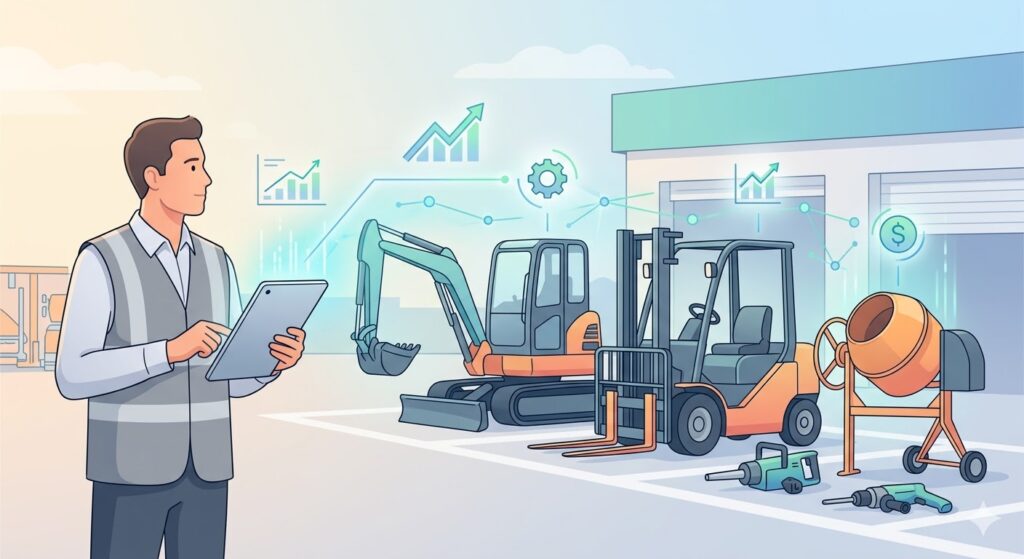
To keep this practical, think through the main areas of your business and how AI can support each one.
7 ways AI improves a Rental Business
| Rental Function | Traditional Approach | AI-Powered Approach |
| Pricing | Fixed rates | Dynamic pricing recommendations |
| Maintenance | Time-based schedules | Predictive maintenance |
| Fleet Planning | Manual analysis | Demand forecasting |
| Dispatch | Manual routing | Route optimization |
| Collections | Reactive follow-up | Payment risk prediction |
To keep this practical, think through the main areas of your business and how AI can support each one.
1. Fleet planning and asset mix
Buying the wrong mix of machines ties up capital and yard space. Many rental companies rely on equipment rental management solutions to improve fleet visibility and utilization before making new purchasing decisions.
AI can read your past years of rental data and help you answer questions such as:
- Which models bring the highest margin over their lifetime.
- Which machines spend too many days idle.
- Which branches could share stock instead of buying more.
- Which assets should move to another location before peak season.
From this, you can build simple rules, like:
- Reduce new purchases for asset groups with low utilization.
- Shift older units to slower branches and keep newer ones where demand is high.
- Sell assets that rarely reach a fair daily rate.
You still decide what to buy.
The data gives you a clearer picture of why.
2. Smarter pricing instead of fixed lists
Static price lists do not match real demand.
You may discount too fast in busy months and hold rates too low when you could earn more.
AI based pricing support can:
- Watch how quickly certain products get booked.
- Compare current demand with past seasons.
- Factor in asset age, condition, and fleet usage.
- Consider customer history and credit behavior.
The output is simple.
For each quote, your team might see:
- A suggested rate range.
- The most likely chance of winning at different points in that range.
- A warning if the discount is too steep compared to similar deals.
Your staff still talks with the customer, but they are not guessing blindly.
Over time, your average rate and utilization both move in a healthier direction.
3. Maintenance before breakdown
Most companies already have basic service plans by hours or dates. Combining AI with preventive maintenance software allows rental businesses to detect risks earlier and reduce costly downtime.
Most companies already have basic service plans by hours or dates.
By analyzing:
- Past breakdowns by model, age, and usage.
- Operator behavior from telematics.
- Environment conditions such as dust or temperature.
- Service history and parts used.
the system can score each unit by failure risk.
This allows you to:
- Plan extra checks on high risk units between bookings.
- Adjust service intervals asset by asset instead of using one rule for all.
- Stock critical parts in the right branches before issues appear.
Your team spends less time reacting and more time preventing problems.
4. Quotes, contracts, and back office work
Sales teams often spend hours on manual tasks that follow the same patterns every day.
AI can help by:
- Reading customer emails that say things like “We need three 20ft scissors from Monday to Friday at our south site.”
It can then build a draft quote with contact details, products, dates, and a suggested rate.
- Suggesting Add Ons commonly sold together with certain equipment.
For example, safety gear, fuel plans, delivery, and pickup.
- Checking contracts for gaps such as missing damage cover or unclear responsibilities.
The outcome is not a robot salesperson. It is a helper that handles set up work so your team can focus on real conversation and negotiation.
5. Transport and dispatch
Transport often feels like a constant juggling act. Trucks leave half full, pickups clash with deliveries, and time windows shift.
AI assisted dispatch tools can:
- Group nearby deliveries and pickups into sensible runs.
- Suggest which truck and driver to assign based on capacity and hours.
- Estimate loading and waiting times for each site, based on history.
- Flag routes that risk overtime or missed arrival windows.
Dispatchers then adjust according to local knowledge.
Fuel, overtime, and customer complaints tend to drop when runs are planned with more data.
6. Finance, risk, and collections
Cash flow is the lifeblood of any rental company. AI can help finance teams manage risk earlier in the process.
For example:
- Score customers based on payment speed, disputes, and contract types.
- Suggest higher deposits or shorter terms for high risk segments.
- Spot contracts where charges and usage do not match patterns for similar deals.
- Predict which invoices will likely need extra attention before they fall overdue.
Collections teams can then:
- Focus early calls on the small set of accounts with higher risk.
- Use standard reminders for low risk, low value invoices.
This leads to fewer surprises and more predictable cash.
7. Customer experience
Customers mostly care about three things:
- Can I get the right machine when I need it.
- Will it work properly on site.
- Will billing match what we agreed.
AI supported tools can help you meet these expectations through:
- Self service portals and chat that answer basic questions about availability, pricing ranges, and delivery times.
- Instant contract views with clear meters, dates, and charges.
- Quick extension quotes based on live data instead of fresh manual calculations.
Your team then handles the complex situations, special terms, and long term agreements.
What the future of AI in rental management might look like
Over the next three to ten years, the individual tools described above will start to connect more tightly. Your rental business may see changes such as:
- A single view of every asset, from purchase order to sale, with live usage, service, and revenue data.
- Quotes that already check availability, transport slots, and risk in the background before your rep hits send.
- Maintenance plans that adapt weekly based on fresh telematics and job site conditions.
- Weekly planning meetings where managers ask “What if” questions and get scenarios based on real numbers.
For example, you might ask:
- “What happens to our return on capital if we sell the bottom 10 percent of underused machines next year.”
- “How many extra rental days could we gain if we reduce breakdowns by 15 percent on one asset family.”
AI will not replace your staff. It will shift their work:
- Sales spend less time on manual entry and more on project level deals.
- Service leaders focus on planning and supplier quality instead of constant emergencies.
- Dispatchers focus on exceptions and customer promises instead of drawing every route from scratch.
- Finance teams spend less time reconciling data and more time on scenario planning.
The companies that benefit most will be those that treat AI as a practical tool inside real processes rather than as a marketing label.
This shift is part of the broader trend of digital transformation in the rental equipment industry, where companies are using connected systems, AI, and automation to improve operational efficiency.
How to prepare your rental business for this future
You do not need massive budgets to start moving in this direction. You need focus, clean data, and clear questions. Here is a simple approach in pointer form.
- Fix the basics of your data
- Clean up product and asset master data.
- Agree on status codes such as “available”, “on rent”, “in transit”, “under repair”, and use them consistently.
- Capture meter readings and return inspections in a structured way.
- Store photos and inspection reports where systems can access them, not in random folders.
- Ask yourself: If an AI model looked at my data today, would it find clear signals or only noise.
- Decide what matters most to you
- Not every company has the same priorities. For the next 12 to 24 months, pick a short list of key questions, such as:
- How can we raise average utilization on high value assets.
- Where do we lose the most margin, discounting or transport.
- Which customers are most likely to cause cash issues.
- Which asset groups should we reduce over the next two years.
These questions guide which AI use cases make sense first.
- Start with one clear use case
Choose something that:
- Uses data you already have.
- Touches a visible part of your P&L.
- Can go live with a small group or branch.
Good examples:
- Pricing suggestions for one product family.
- Maintenance risk alerts for a limited set of machines.
- Email to quote support for a small sales team.
Define a simple target such as:
- “Increase achieved daily rate by 3 percent on this product family within a year.”
- “Reduce emergency breakdowns on these machines by 20 percent.”
- Involve your team from day one
AI will change habits and roles. People may worry about losing control or being judged by a system.
Make them partners, not subjects:
- Ask mechanics where they see repeated failures.
- Ask dispatchers what makes planning hard each day.
- Ask sales which admin tasks slow them down most.
When the first tools appear, they will match real needs, not only IT goals.
Choose partners carefully
When speaking with software vendors or internal IT teams, stay practical.
Helpful questions include:
- Which specific data do you need from our rental system.
- How will you connect with our existing ERP and finance tools.
- Can we start with one branch and then extend.
- How do you explain your model results to non technical staff.
- How do we get our data back if we change direction.
Look for clarity over hype.
If you cannot explain the benefit to your staff in two or three sentences, the project may be too vague.
Measure results in plain business terms
For each AI use case, track:
- Revenue impact.
- Cost savings.
- Time saved for staff.
- Reduction in disputes or breakdowns.
Share these numbers openly inside the company.
When people see real effects, they are more willing to support the next step.
Conclusion
AI will not fix weak assets, poor service, or unclear contracts. Those still need human judgment and leadership.
What AI can give you is:
- Better visibility into which assets truly earn their place in the fleet.
- Earlier warnings on risk, whether technical, financial, or operational.
- Help with thousands of small decisions that shape your margin every month.
You already hold much of the raw material in your rental, telematics, and finance data.
AI turns that raw material into guidance, if you let it.
The coming years will reward rental companies that combine:
- Clean and honest data.
- Clear business questions.
- Small, focused projects that prove value.
- Teams who are willing to work with new tools rather than fight them.
If you start with one area, learn from it, and then move on to the next. You will slowly build a rental operation where AI is present in the background, helping your people make sharper decisions every day.
How Prexa365 Helps Rental Businesses Use AI Effectively
Prexa365 combines rental operations, fleet visibility, preventive maintenance, financial management, and AI-powered insights in a single platform. Instead of managing disconnected systems, rental businesses can use one solution to improve utilization, reduce downtime, and streamline customer service.
Conclusion
AI will not fix weak assets, poor service, or unclear contracts. Those still need human judgment and leadership.
The future of AI in rental management software is not about replacing people – it’s about helping teams make faster, smarter, and more profitable decisions. Companies that start improving data quality and adopting targeted AI use cases today will be better positioned for tomorrow’s rental market.
Ready to see AI-powered rental management in action? Request a free demo or contact the expert team today!
Frequently Asked Questions
Will AI replace rental management teams?
No. The role of AI in rental management is not to replace human staff but to change how they make decisions. AI handles heavy data analysis, repetitive patterns, and manual setup work (like drafting quotes from emails), allowing staff to focus on high level tasks like complex negotiation, project planning, and exception handling.
How does AI help with fleet utilization and planning?
AI analyzes past years of rental data to identify which models generate the highest margins, which machines sit idle too often, and which assets should move between branches before peak season. This helps managers move away from “gut feeling” decisions and build simple, data-backed rules for new purchases and asset disposal.
What is the difference between traditional service scheduling and AI-driven maintenance?
Most rental companies use basic service plans based strictly on hours or dates. AI-driven predictive maintenance analyzes telematics (like operator behavior and environment conditions) along with past breakdown history to create a risk score for each unit. This allows teams to plan extra checks on high risk assets before they fail on a job site.
How can a rental business prepare for AI implementation?
Preparation does not require a massive budget. Businesses should focus first on fixing the basics of their data, such as cleaning up product master data, enforcing consistent status codes (e.g., “available” vs “under repair”), and capturing structured inspection reports. Once data is clean, the best approach is to start with one clear, measurable use case (like pricing suggestions for one product family) before expanding.


